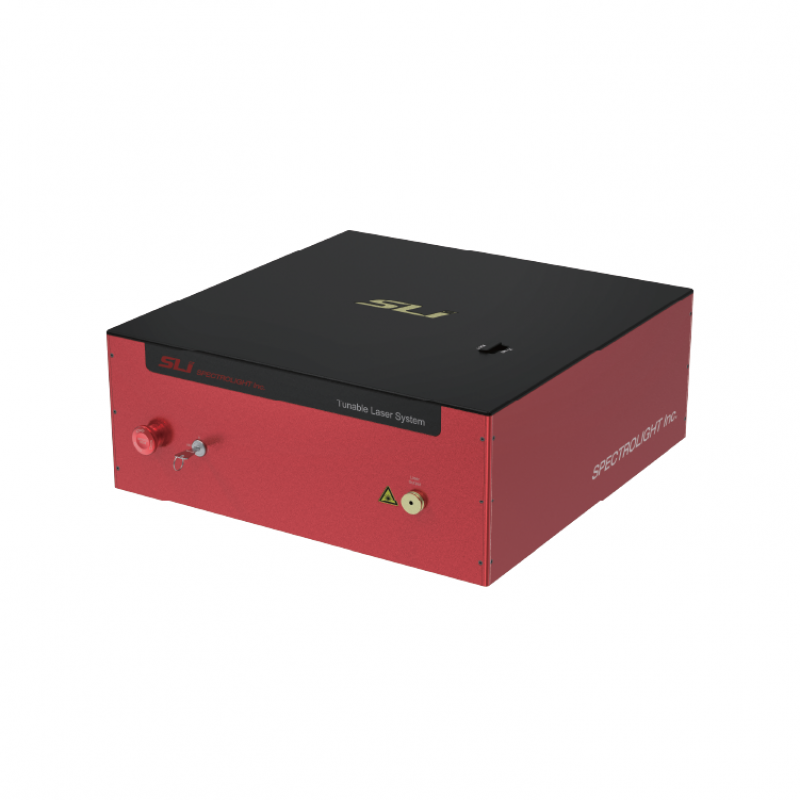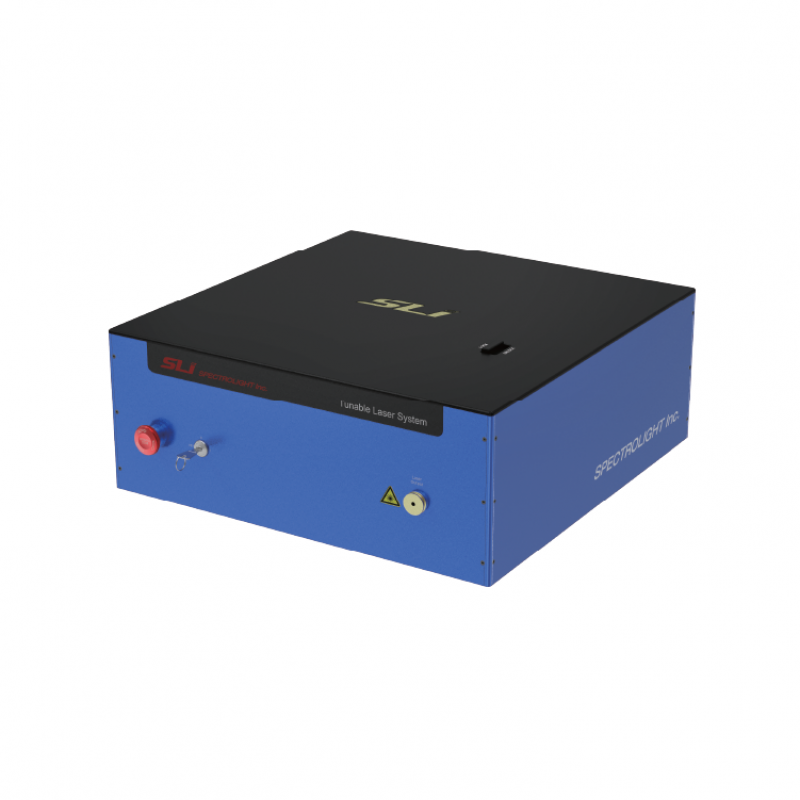


Tunable Laser Systems
Any λ(lambda) any Δλ (delta lambda)
The World’s Widest Tunable Laser System (TLS)
ㅡ 1 nm Precision / 410–1700 nm Tuning Range ㅡ
Fully Tunable Picosecond Pulsed Laser System
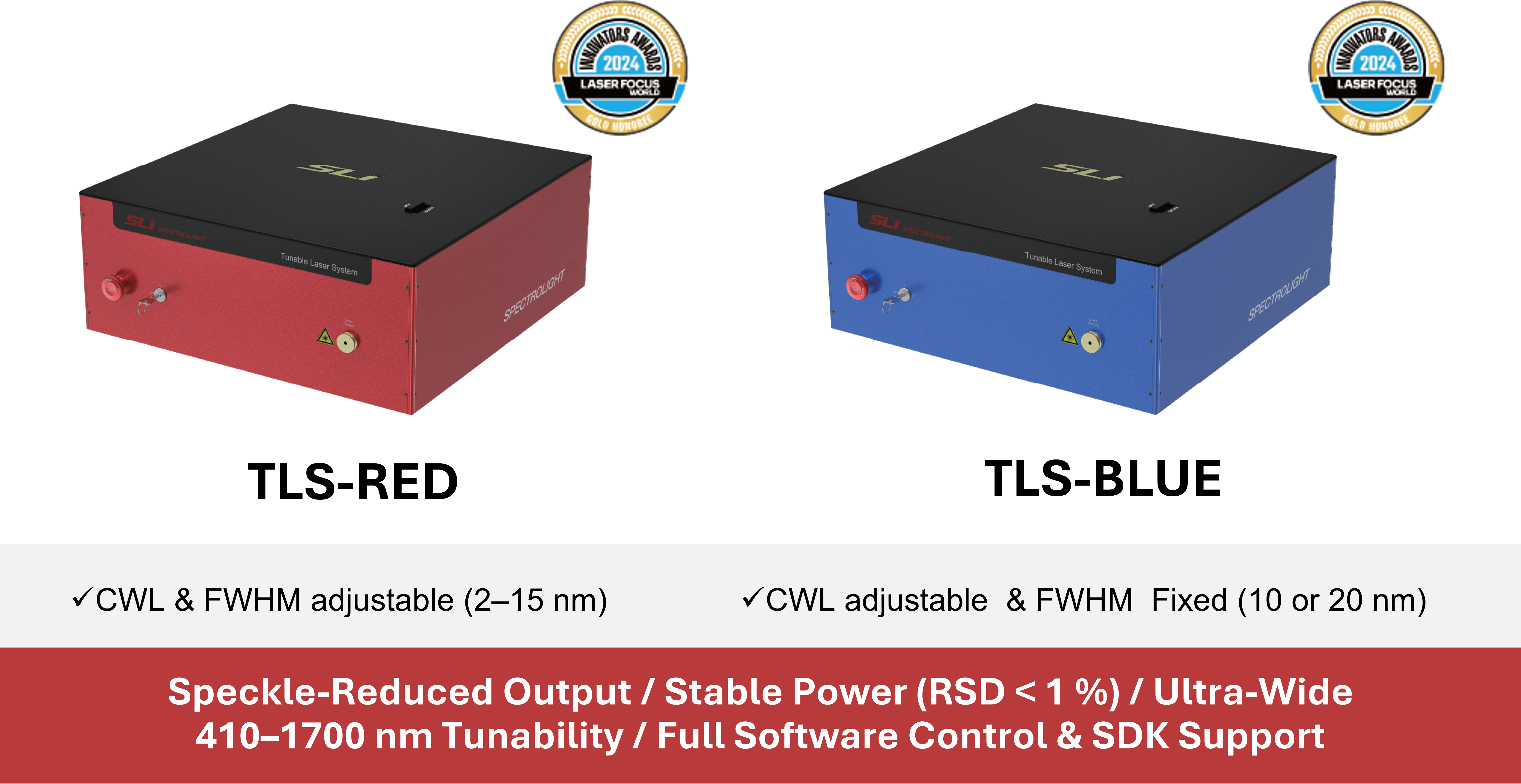
The SPECTROLIGHT TLS is a fully tunable laser system combining a picosecond
supercontinuum source with a precision bandpass filter — enabling users to
freely select any wavelength from 410 to 1700 nm with exceptional stability and clarity.
Product Highlights
|
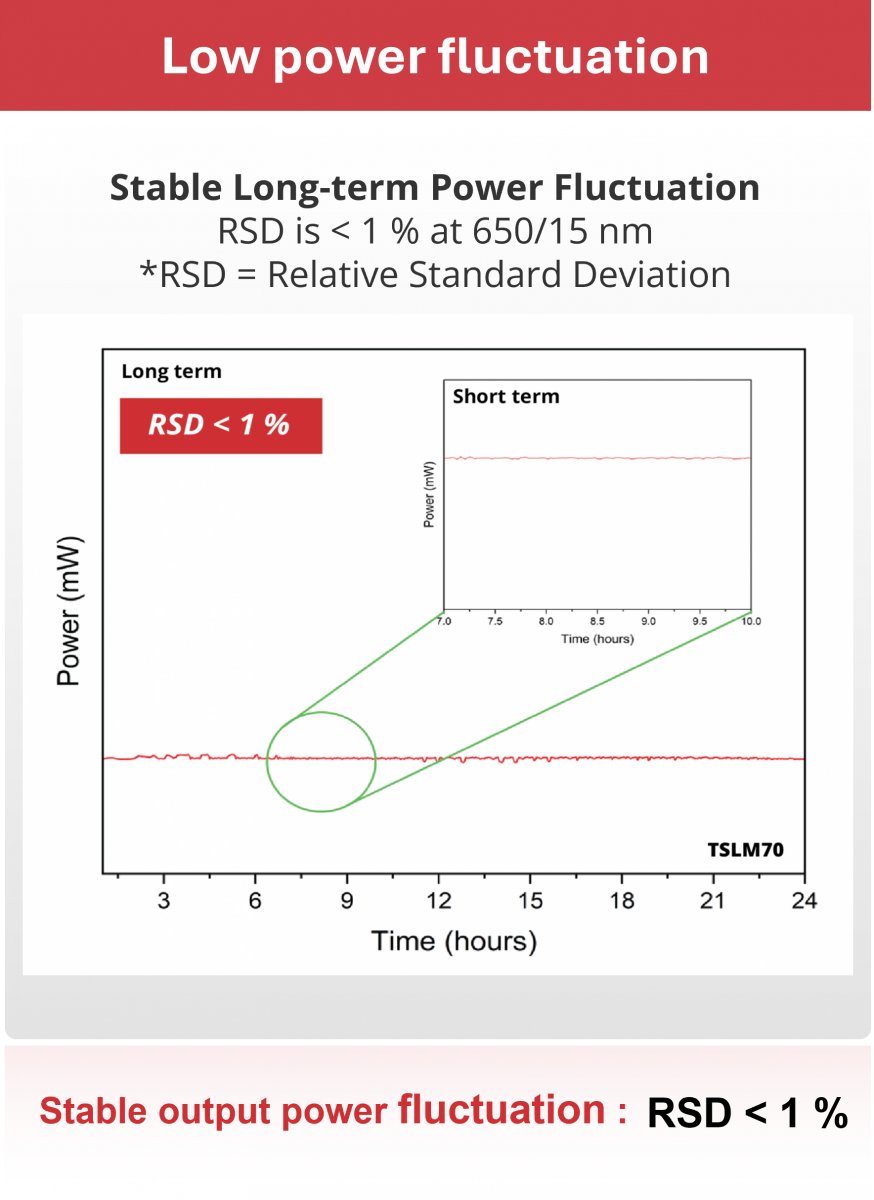
Stable output power fluctuation RSD < 1 % |
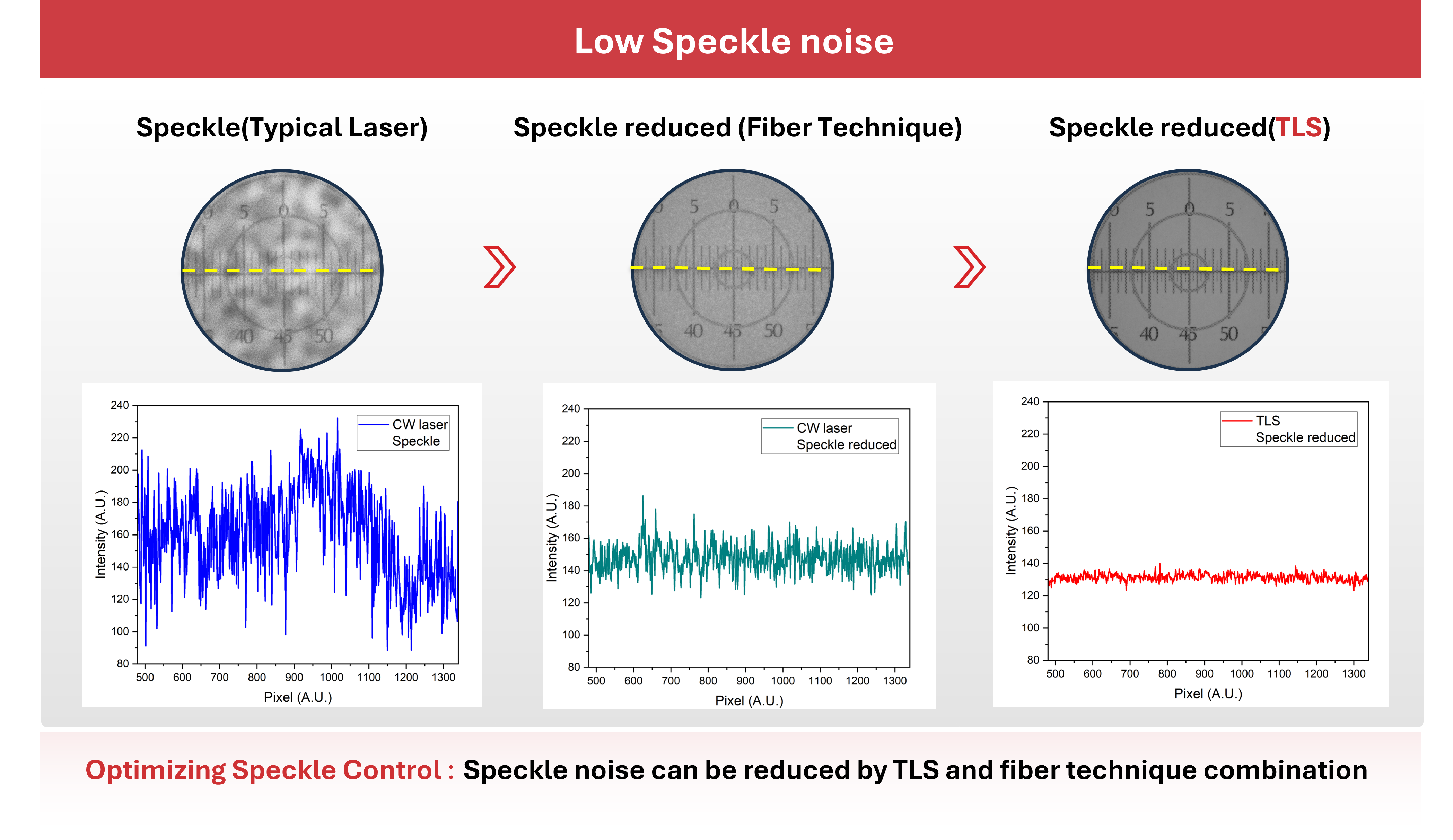
Reduced Laser speckle noise Ideal for imaging applications |
|
Broadband tunability up to SWIR (410–1700 nm) The world's first wide continuous tunable CWL & FWHM |
Wavelength uniformity inside the beam Uniform wavelength distribution beam |
|
High output power : > 40 mW (Maximum power at 10 nm FWHM) Suitable for spectral imaging with wide applications |
High out of band blocking (> 80 dB: OD 10) Blocking unwanted wavelength up to 1700 nm |
|
Bandwidth fixed and adjustable Fixed (10, or 20 nm), Adjustable (2–15 nm, nominal) |
High pointing stability No beam position drifts for long distanc |
|
Various models depend on Power Total Power : 1, 2, 3.5, 4, 7, 8 W or more |
Various types of repetition rates Fixed: 2,10,20,40,80 MHz / Variable: 0.01–200 MHz |
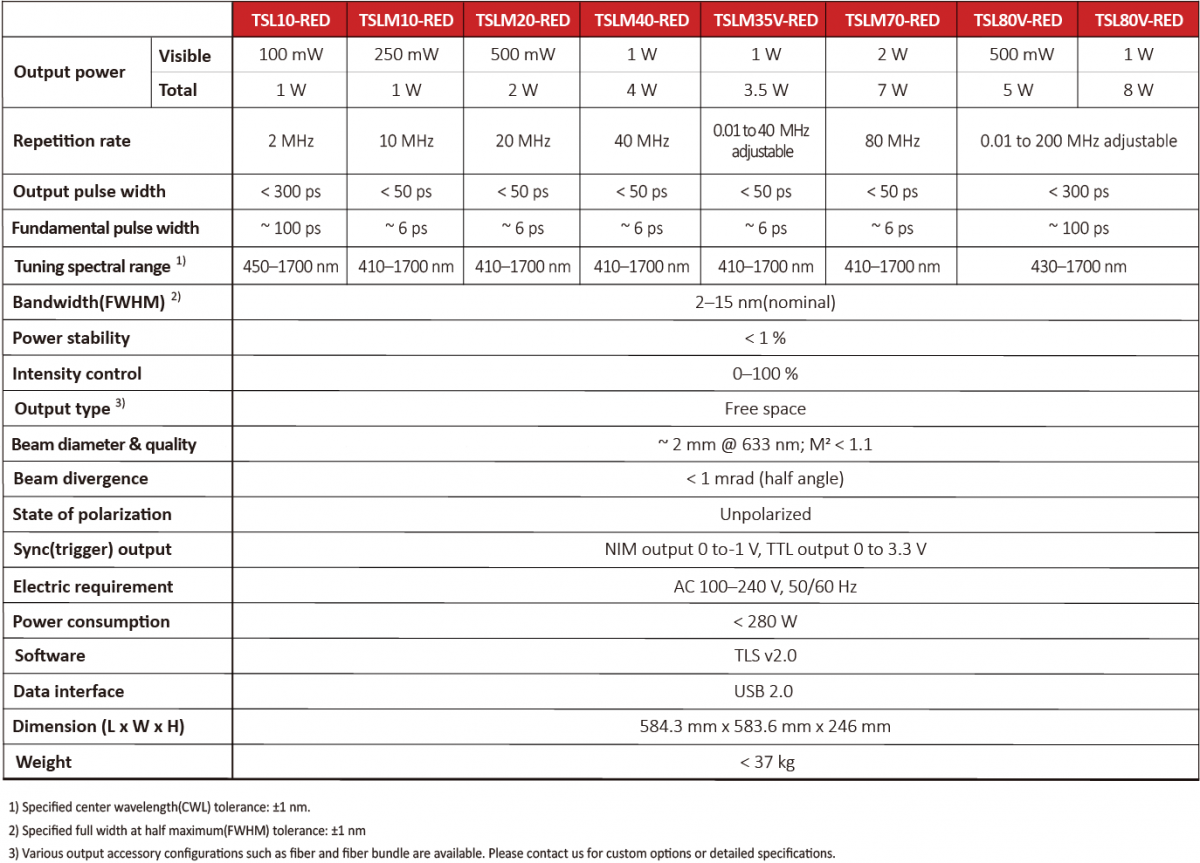
TLS Output Power Overview
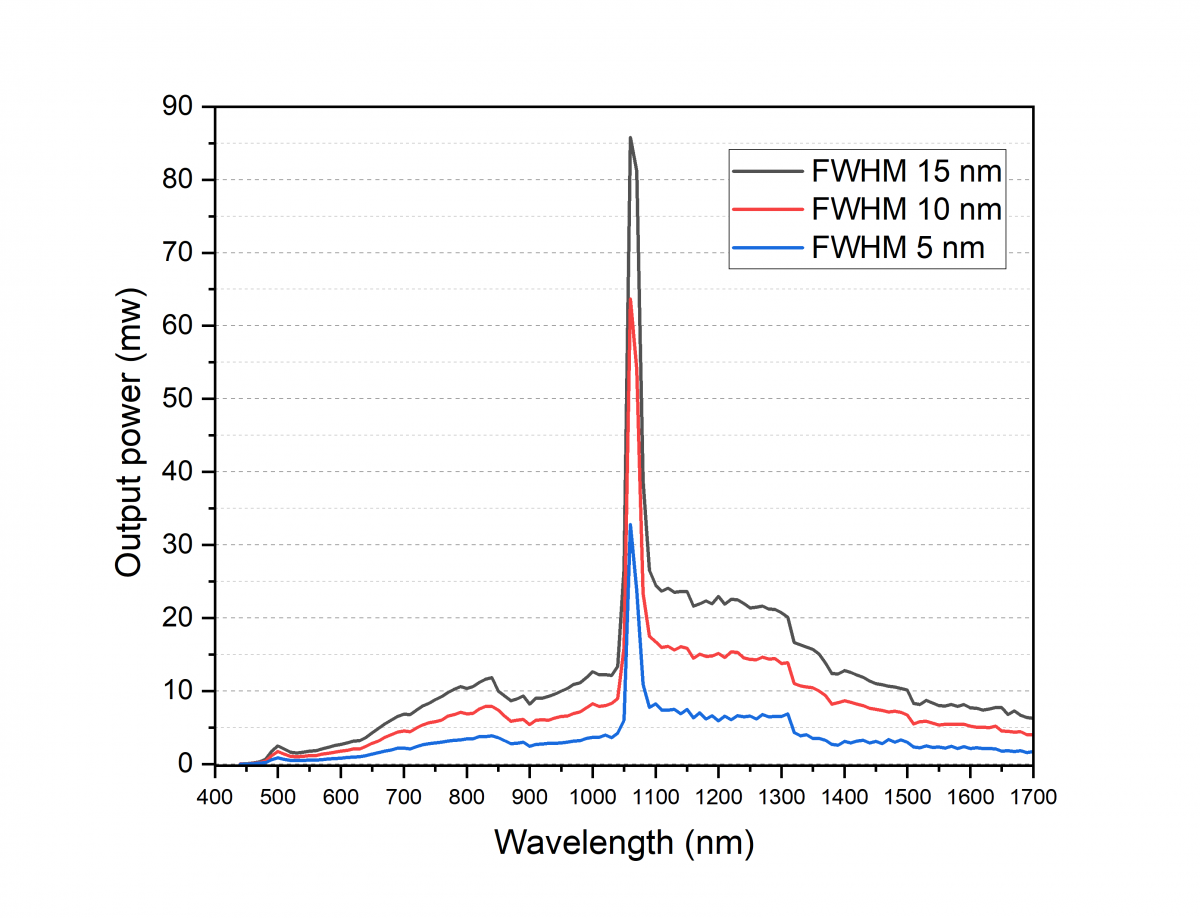
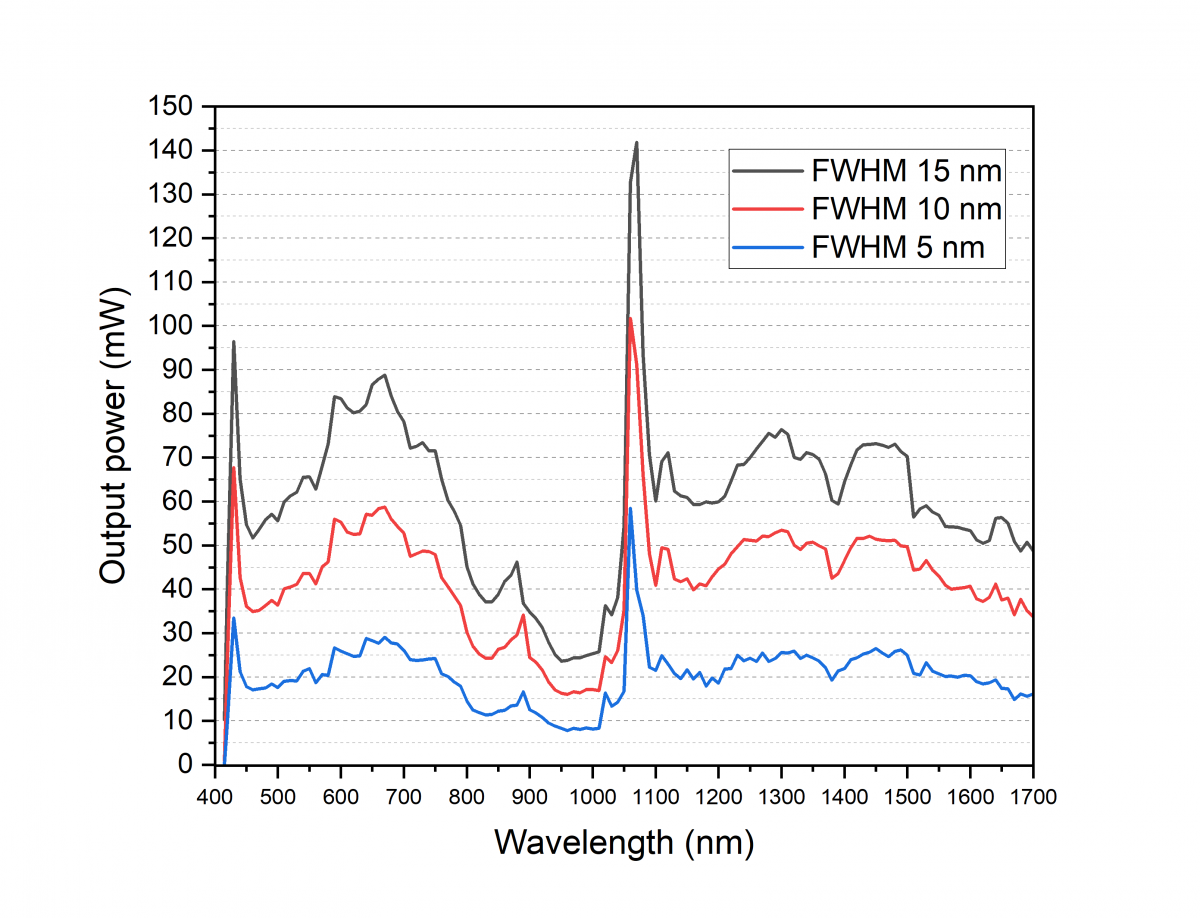
Representative RED models: TSL10-RED vs TSLM70-RED
Broadband tunable output from 410 to 1700 nm with different FWHM options.
TSL10-RED
Laser type: Gain-switched Supercontinuum laser
TSLM70-RED
Laser type: Mode-locked Supercontinuum laser
Specifications
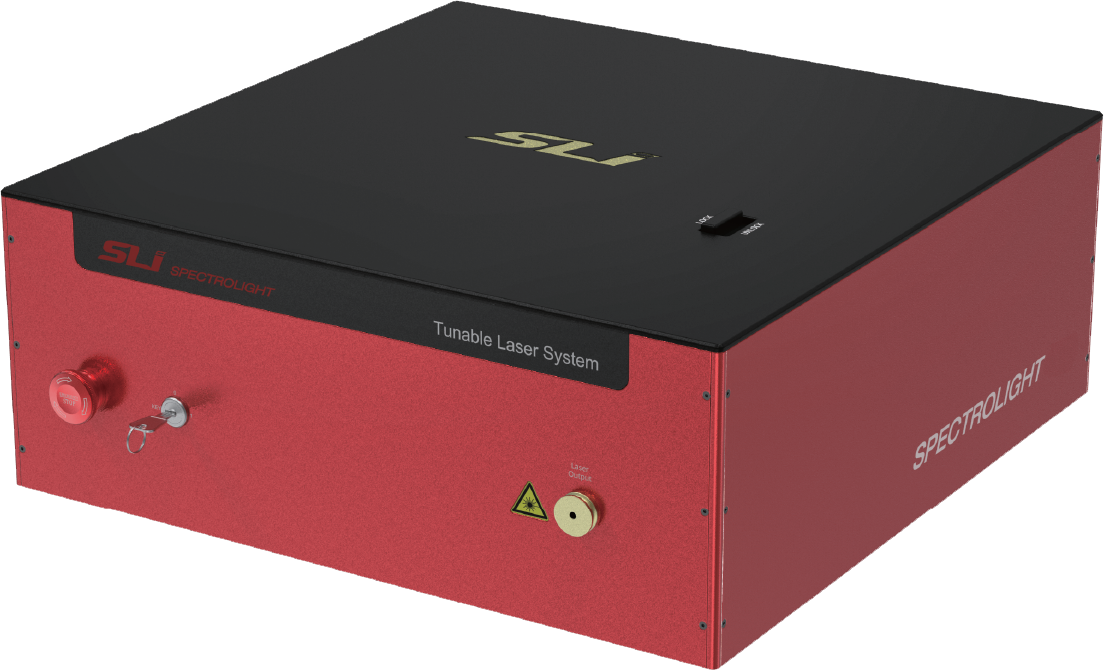
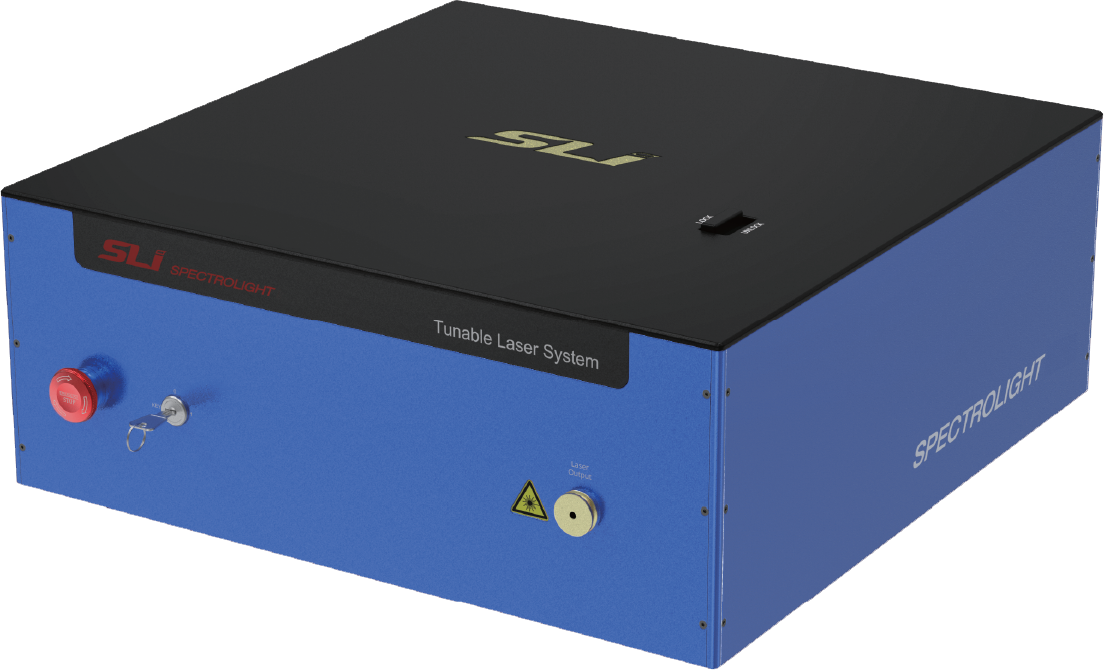
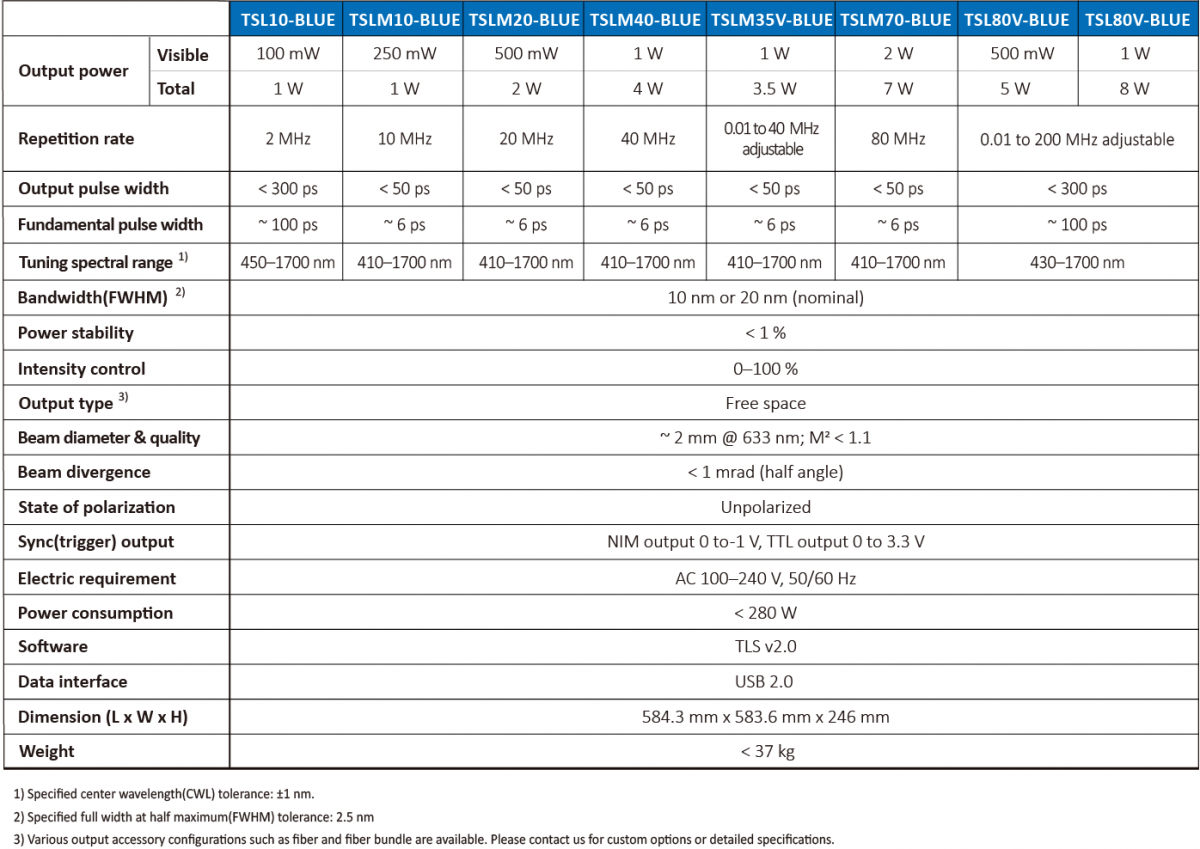
Choose Your Model: TLS RED/TLS BLUE
Each TLS has VIS, IR, SWIR, and Custom wavelength selection
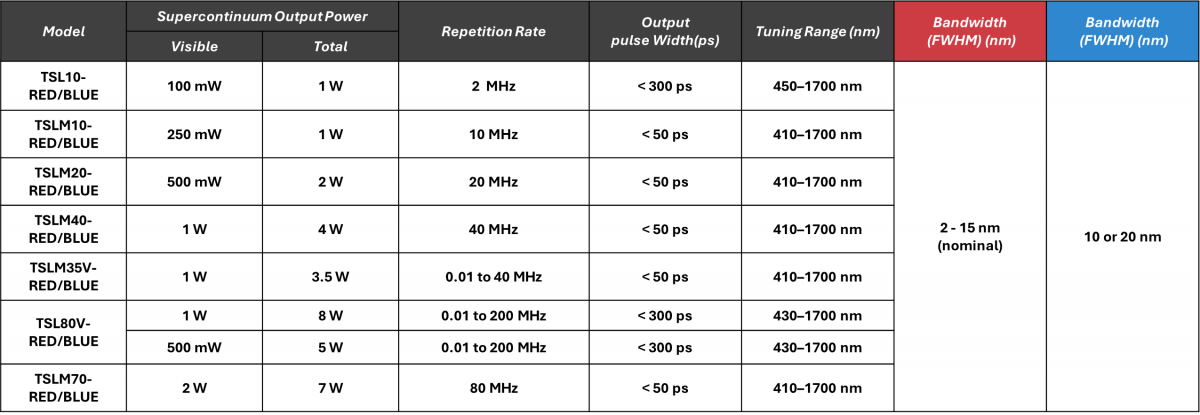

Users can select a supercontinuum laser model and variable wavelength ranges
according to the user’s applications for custom model.
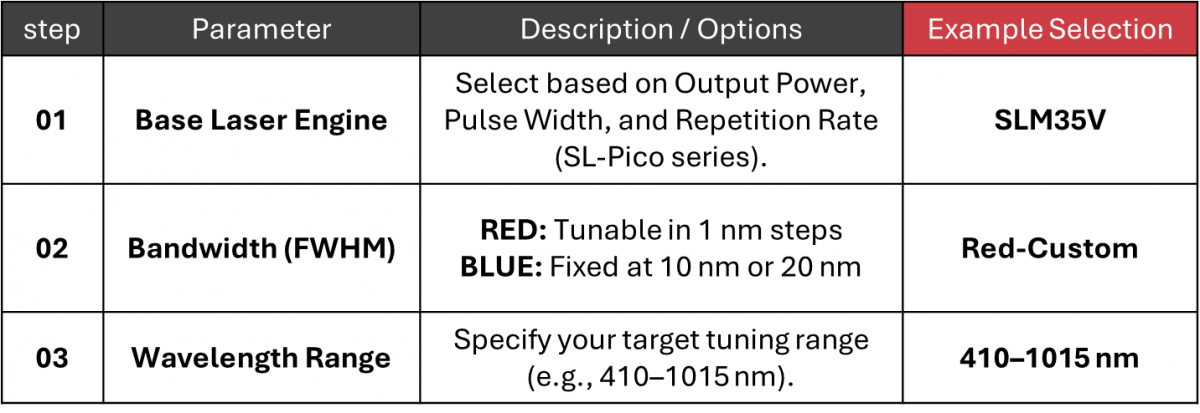
SPECTROLIGHT TLS Configuration Guide
The SPECTROLIGHT TLS can be fully customized to meet your specific application requirements.
Follow these three simple steps to configure your ideal system:
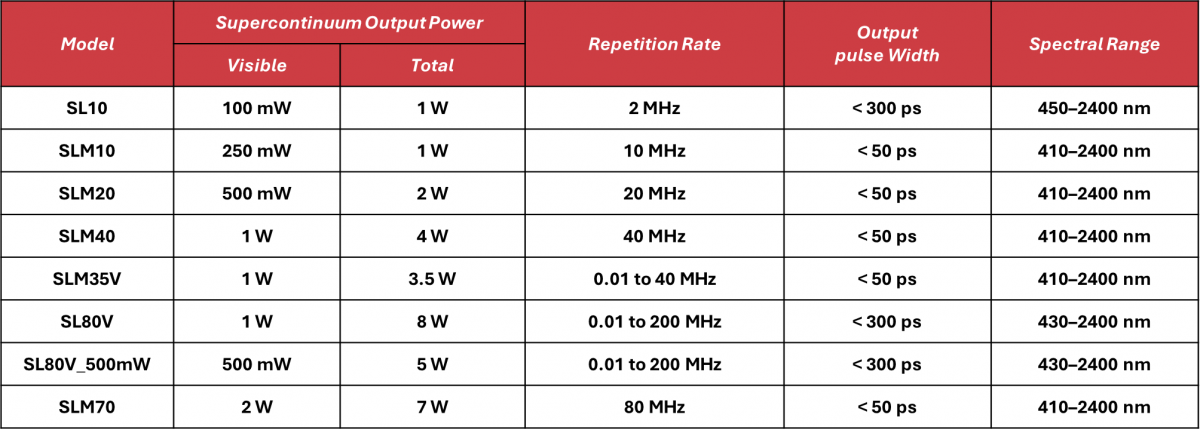
Step 1: Select Your Light Source (SL-Pico Series)
Choose the base laser engine by considering your required output power,
pulse width, and repetition rate.

Example: SLM35V
The supercontinuum laser model table
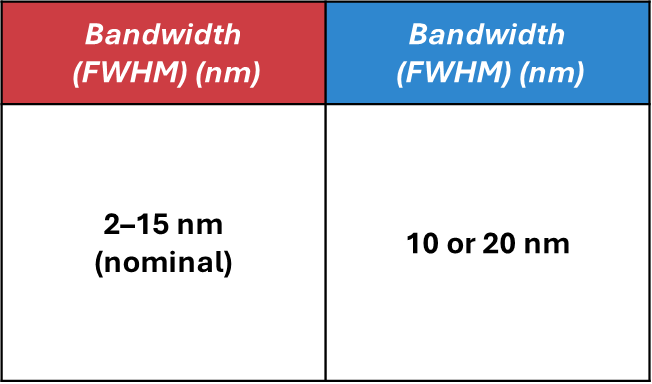
Step 2: Choose Your Bandwidth (FWHM) Functionality
Decide whether you need an adjustable or fixed bandwidth.
Example: Red-Custom
Wavelength range table
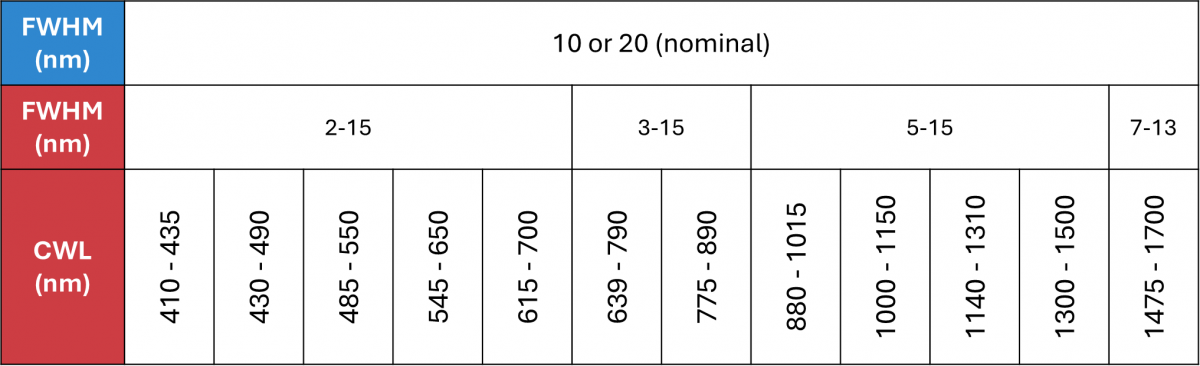
Step 3: Define Your Wavelength Tuning Range
Specify the exact spectral range required for your application.
Example: 410–1015 nm
Wavelength range table
(Flexible Wavelength Selector: Poly-RED)
Your Final Model Configuration
Resulting Model Number
TSLM35V-Red-Custom
(410–1015 nm)
Application
Versatile tunable illumination for research and industry.
|
Main Category |
Representative Application Areas |
|
Basic Science & Optics |
Optical experiments, photo-detection, interferometry, adaptive optics, quantum & holographic imaging |
|
Life Science & Biotechnology |
Fluorescence / confocal microscopy, optogenetics, bio-inspired vision systems, drug discovery |
|
Materials & Nanotechnology |
Photoluminescence (PL), Raman spectroscopy, thin-film and nanomaterial characterization, nonlinear optics |
|
Industrial Metrology & Inspection |
Wafer and micro-LED inspection, optical component QC, camera calibration, surface uniformity analysis |
|
Medical & Diagnostic Imaging |
Non-invasive tissue or vein visualization, biomedical fluorescence excitation, optical absorption studies |
|
Environmental & Chemical Analysis |
Water / air quality spectroscopy, gas absorption and scattering measurements |
|
Hyperspectral & Multispectral Imaging |
Tunable illumination for hyperspectral cameras, calibration and testing of imaging systems |
|
Energy & Photovoltaics |
Spectral responsivity testing of solar cells, optical material reflectance / transmittance measurement |
|
Quantum & Advanced Optics |
Transient absorption and carrier lifetime studies, photon correlation, plasmonic and near-field optics |
TLS provides wavelength-selectable illumination covering UV to NIR,
enabling a wide range of optical and photonic experiments.
It has been utilized in research areas including transient absorption,
holographic interferometry, and spectroscopic material characterization,
demonstrating its flexibility as a reliable tunable light source.
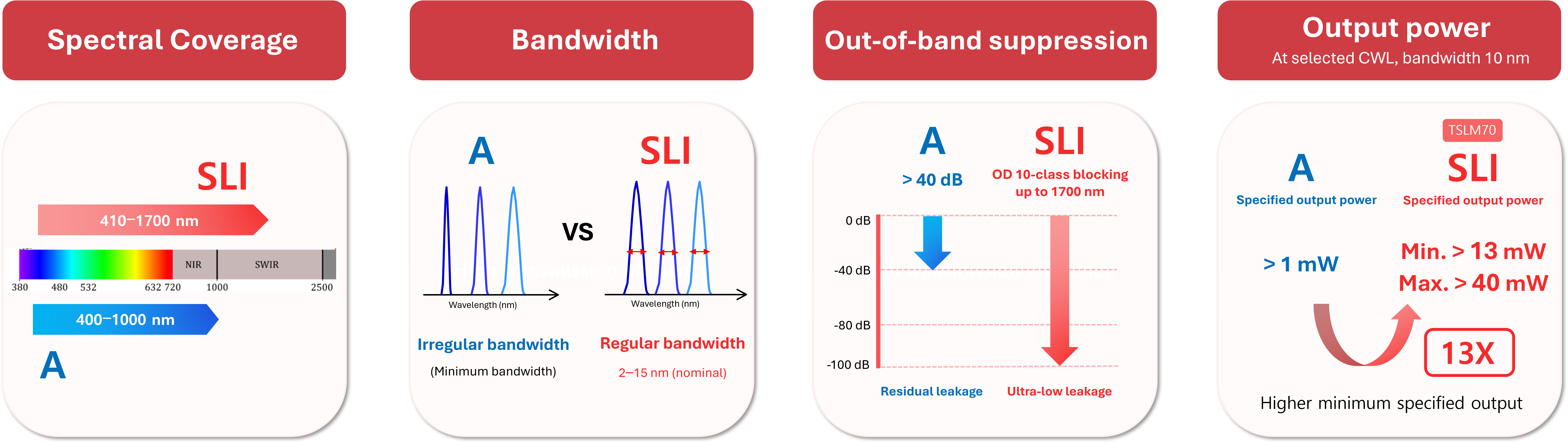
Why Choose TLS?
A : Conventional
SLI : SPECTROLIGHT
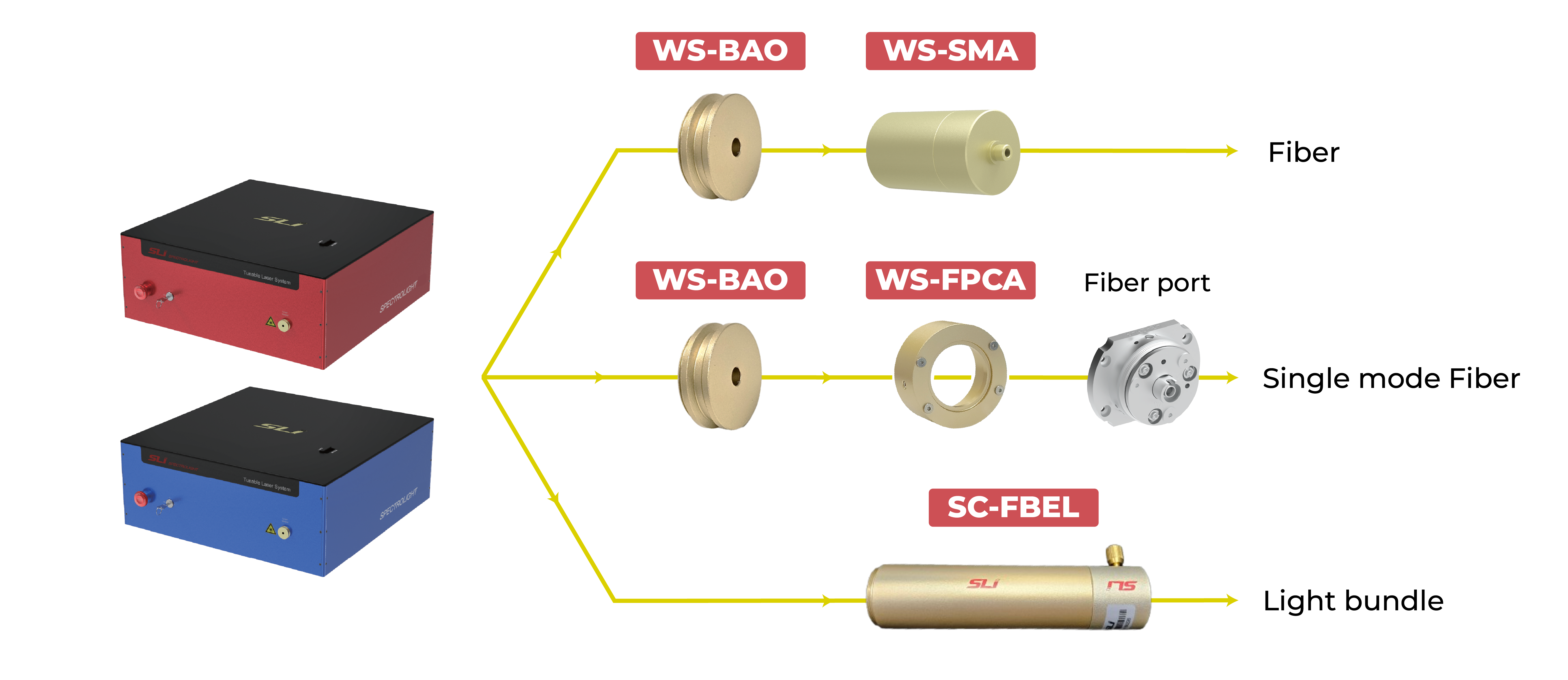
Accessories